
The Tamara Lich trial shows just how far Ottawa will go to crush dissent, especially in the West

Tamara Lich’s prosecution isn’t just about a protest—it’s a warning. For many Western Canadians, her harsh treatment by Ottawa signals how far the federal government is willing to go to silence dissent. As Alberta moves toward a sovereignty referendum, Lich’s ordeal stands as a troubling omen of how Ottawa may respond to serious challenges to its authority.
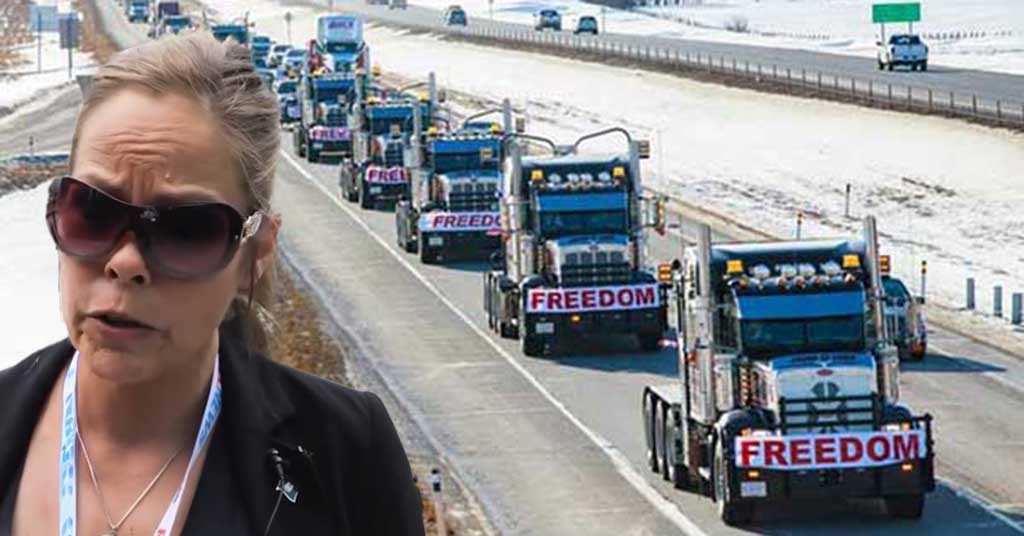
Lich, a key organizer of the 2022 Freedom Convoy protest in Ottawa, became a central figure in a nationwide debate over pandemic mandates and civil liberties. She travelled to Ottawa to protest what she and many Canadians viewed as the federal government’s heavy-handed pandemic measures. Rather than respond with dialogue, the Trudeau government cracked down—hard. Lich was arrested, denied bail and now faces a potential seven-year sentence for her role in the peaceful protest.
That sentence exceeds those handed to violent offenders in some cases. One man, for example, stabbed his girlfriend three times and hit another woman with a pipe—yet received only a short sentence. Lich, meanwhile, faces seven years for mischief and breaching bail conditions. That’s not justice. It’s deterrence by example.
The disparity becomes even more striking when viewed in the broader context of the Freedom Convoy itself. The protest began in early 2022, when thousands of truckers and their supporters drove to Ottawa to oppose federal COVID-19 vaccine mandates, especially for cross-border drivers. The demonstration, which blocked downtown streets for several weeks, drew both support and condemnation across the country.
While the protest was disruptive, it was peaceful. That stands in contrast to the leniency shown toward other protest movements that involved far more dangerous actions. Protesters involved in the Wet’suwet’en rail blockades, Black Lives Matter demonstrations, or recent pro-Hamas marches engaged in activities that included burning rail tracks, toppling statues and threatening public safety, yet many escaped charges entirely or received minimal penalties. In Lich’s case, even honking a horn has been treated like a criminal conspiracy.
So what exactly did Tamara Lich do? She helped organize a peaceful protest. She spoke out against government overreach. She called for a meeting with the prime minister. That’s it.
The trucker-led convoy that she helped inspire emerged in response to a final, baffling mandate: that cross-border truckers be vaccinated against COVID-19. This came long after it was clear the vaccines didn’t prevent transmission. The mandate was political, not scientific. The truckers knew it. Ottawa knew it. Yet instead of backing down, the Trudeau government doubled down.
And this wasn’t an isolated example of government excess. Throughout the pandemic, Ottawa pushed increasingly arbitrary and often absurd restrictions. Playgrounds were closed. People were told to stay indoors and avoid outdoor air. Provincial premiers were pressured into compliance by threats to federal funding. Rules shifted weekly, often with little logic or explanation.
When Canadians finally pushed back, they weren’t met with humility or dialogue. They were met with insults. Trudeau had earlier described unvaccinated Canadians as “often misogynists, also often racists,” questioning whether society should “tolerate these people”—remarks widely seen as contributing to the hostile tone later directed at convoy protesters.
He refused to meet with them. He retreated to his cottage and then reached for the Emergencies Act—the first time it had ever been used in Canadian history, raising serious civil liberties concerns across the political spectrum.
It froze bank accounts, targeted private citizens and brought down the full weight of the state on people who were engaged in peaceful civil disobedience.
The legacy media echoed the government line, portraying protesters as dangerous extremists. The Ottawa police became aggressive. Even the chief justice of the Supreme Court made comments that blurred the line between judicial neutrality and political messaging. The signal was unmistakable: dissent would not be tolerated.
Why such an overreaction? Because the protest threatened not public safety, but political control. It exposed the disconnect between ordinary Canadians and the Ottawa elite, and it risked uniting voters across regional and political lines.
So the federal government chose to make an example of Lich. In doing so, they sent a chilling message: resist us, and we will ruin you.
That message matters now more than ever. Alberta is preparing for a sovereignty referendum—a vote designed to test whether the province should assert more control over taxation, natural resources and other federal matters. If Lich’s treatment is any indication, Ottawa will not respond kindly.
Expect the full machinery of the federal government, legal, financial and rhetorical, to be deployed to crush dissent, divide communities and discredit the movement.
There’s an old expression: punish a few to scare the many.
That’s what has happened here. Lich’s ordeal is not about justice. It’s about power. It’s about control. And it’s about sending a warning to anyone who dares question the authority of the federal government.
Lich will be remembered as a heroine in the West and a troublemaker in the East—a divide that says more about Canada than it does about her.
Her treatment is not the mark of a healthy democracy. It’s the sign of a government that no longer tolerates dissent. And it’s a very bad omen for Western Canadians who still believe in the right to speak out, stand up and say no.
Brian Giesbrecht is a retired judge and a senior fellow at the Frontier Centre for Public Policy.
Explore more on Trudeau government, Human Rights, Democracy, Abuse of power, Free speech
The views, opinions, and positions expressed by our columnists and contributors are solely their own and do not necessarily reflect those of our publication.
Troy Media empowers Canadian community news outlets by providing independent, insightful analysis and commentary. Our mission is to support local media in helping Canadians stay informed and engaged by delivering reliable content that strengthens community connections and deepens understanding across the country.

