
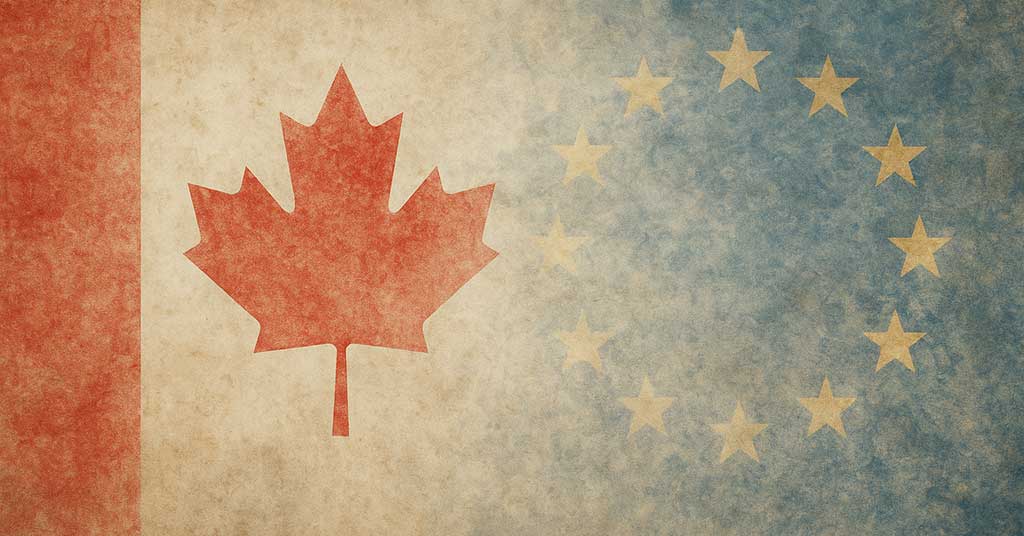
Europe once had influence and lost it. Canada never had it. Now both confuse empty rhetoric with real influence

Europe talks like it still matters. But behind the speeches and ceremonies lies a hard truth: France and Britain have lost the will—and the means—to shape the world. Canada, lost in post-national fantasy, is following them into irrelevance.
French President Emmanuel Macron recently stood before the UK Parliament and declared, “We will save Europe by our example and our solidarity.” It sounded noble. But nobility without the power to act is just performance. Europe’s elites, once able to shape history, now offer only gestures.
Soon after, Prime Minister Mark Carney joined Macron and UK Prime Minister Keir Starmer in calling for a Gaza ceasefire. The statement didn’t sit well with Israel, but it wasn’t meant to. It was symbolic: a comfortable pose by leaders who speak as if they can shape outcomes without paying a price. While all three speak boldly, no one’s listening.
History has seen this performance before—and nowhere more clearly than in the 1956 Suez Crisis. When Egyptian President Gamal Abdel Nasser nationalized the Suez Canal—a vital shipping route between Europe and Asia that symbolized European control of global trade—Britain and France, then still major world players, allied with Israel in a military bid to retake the waterway.
It didn’t go well. The old colonial powers were checked by the true postwar superpowers: the United States and the rising Soviet Union. The Anglo-French-Israeli alliance fractured. The lesson was clear: Britain and France could no longer project force alone. Apart from Britain’s limited success in the Falklands decades later, Europe’s military independence had ended.
Although diplomatically rebuked, Israel demonstrated its military edge by swiftly defeating Egyptian forces in the Sinai, just as it had in 1948 and would again in 1967. Unlike Europe, Israel emerged from the Suez moment with a sharpened sense of national resolve. The crisis marked a growing philosophical break from Europe.
This divergence wasn’t only military—it was also intellectual.
Zionism was a thoroughly European idea—an outgrowth of 19th-century liberalism, socialism and nationalism. It rejected earlier Jewish assimilationism and, after the Holocaust, embraced sovereignty.
The early Israeli state still moved in Europe’s orbit, but Suez and the Six-Day War in 1967 confirmed its separation. This turning point was more than diplomatic—it marked Israel’s assertion of a distinct national will, grounded in sovereignty rather than European idealism.
Israel didn’t just exist—it willed itself to exist. The phrase “right to exist” means little in practice. Nations persist because they insist on doing so, through trade, diplomacy and, if needed, war. On that measure, Israel is one of the most “existent” nations alive today. The United States isn’t far behind.
Europe, by contrast, seems intent on vanishing. Where Israel affirms national purpose, Europe recedes into abstract ideals—international law, universal humanity and post-national identity. This idea—that a country is no longer defined by shared history, culture or borders but by universal values—is now deeply embedded in the political thinking of many European leaders. In Canada, it has taken hold among our own governing class as well.
While Europe dreams of extending its influence through idealism, others are redrawing the map with more forceful tools. Nowhere is this clearer than in Turkey, where the fantasy of EU accession has effectively ended—talks have been frozen since 2016 amid democratic and rule-of-law concerns. Under President Recep Tayyip Erdoğan, Turkey has embraced imperial Islamism, severing its claim to European modernity.
If Turkey marks Europe’s southeastern edge, then Ukraine and Russia shape its eastern frontier. Russia’s neo-Eurasianist doctrine—an ideology that rejects Western liberalism and sees Russia as the centre of a distinct Eurasian civilization—challenges Europe’s slumber. But its uneven response to the Ukraine war reveals how hollow its convictions have become.
If France and Britain are to recover any meaningful global standing, they must reassert their national identities—not as relics of empire, but as confident, coherent political actors. That may include some return to the Christianity that shaped European politics for millennia. What they cannot afford is continued submission to the fantasy of a politics-free humanity.
As for Canada, we must abandon our post-national illusions. We may learn from European allies or rising Asian powers, but we are not “of” Europe and never will be. Our destiny, if we care to shape one, lies in renewed engagement with our unpredictable but indispensable southern neighbour.
Canada once helped resolve the Suez Crisis through diplomacy. But today’s crisis is more existential than military. And the consequences are already visible: in our muddled foreign policy, our reluctance to defend national interests, and our unwillingness to define what Canada even stands for. We must decide whether we still have the will to exist as a nation, or whether we will continue mistaking sentiment for strength.
Collin May is a Senior Fellow with the Frontier Centre for Public Policy, a lawyer, and Adjunct Lecturer in Community Health Sciences at the University of Calgary, with degrees in law (Dalhousie University), a Masters in Theological Studies (Harvard) and a Diplome d’etudes approfondies (Ecole des hautes etudes, Paris).
Explore more on Nationalism, International relations, History, Democracy
The views, opinions, and positions expressed by our columnists and contributors are solely their own and do not necessarily reflect those of our publication.
Troy Media empowers Canadian community news outlets by providing independent, insightful analysis and commentary. Our mission is to support local media in helping Canadians stay informed and engaged by delivering reliable content that strengthens community connections and deepens understanding across the country.

