
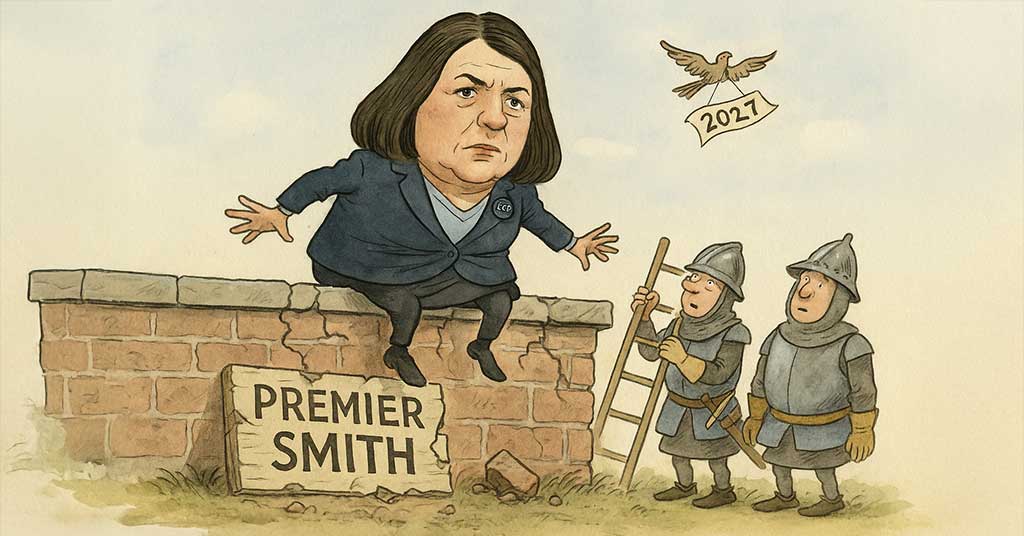
Smith’s gamble on the radical right is pushing moderates out and leaving the UCP on shaky ground for 2027

Alberta’s United Conservative Party is coming apart at the seams, and Premier Danielle Smith may not be able to stitch it back together. As she bends to the demands of the radical right, moderates are walking away, leaving the 2027 election perilously wide open.
The UCP isn’t just another provincial party. As Alberta’s governing party, it shapes the future of a province that drives much of Canada’s energy economy. What happens here matters across the country.
The “United” in United Conservatives has always been a stretch. Born in 2017 from a shotgun marriage between Progressive Conservatives and Wildrose, the alliance was built to block the NDP, not out of shared philosophy. The old PCs were fiscally conservative but carried a social conscience. The Wildrose were hard-line small-government purists, convinced only they represented true conservatism.
Smith’s comeback hinged on coaxing Wildrose loyalists back into the fold after her earlier defection, exploiting the PCs’ weakness after years of scandal and poor leadership. It worked for a while. But forced unions always have a best-before date.
The radicals have only grown bolder. Their agenda ranges from dismantling renewable energy to weakening public education and embracing fringe medical theories. Now they are pushing Alberta out of Confederation, an idea that once lived on the political margins but has gained traction among conservatives who argue Ottawa is hostile to Alberta’s oil-driven economy. Rather than draw a line, Smith has hosted Alberta Next events where separation is treated as a legitimate topic. Whether she’s pandering or sympathizing is anyone’s guess.
And still, it isn’t enough. A new Republican Party of Alberta has already been formed, demanding referendums on independence and even joining the United States. Smith’s give-’em-an-inch approach has backfired spectacularly.
Meanwhile, moderates are rebelling. Former infrastructure minister Peter Guthrie resigned from cabinet over concerns about questionable contracts and was expelled from caucus after calling for a judicial inquiry. Backbencher Scott Sinclair was kicked out for opposing a budget that funnelled $183 million into projects tied to the Edmonton Oilers while rural health care and road safety were left wanting.
Now, Guthrie and Sinclair are leading an effort to revive the Progressive Conservative Association of Alberta, which governed from 1971 to 2015. They face an ambitious goal of nearly 9,000 verified signatures and 45 candidates by November. Success is uncertain, but the symbolism is powerful.
The late premier Peter Lougheed once made the distinction crystal clear. At a social event, when asked about the PCs’ hard-right drift, he cut off the conversation. “I’m a PROGRESSIVE Conservative,” he roared before stomping away. It was a reminder that Alberta’s conservative tradition was once rooted in balance, fiscal prudence tempered with a social conscience.
As someone who watched the PCs stumble after Ralph Klein, I find it ironic that anyone looks back to that period with longing. It was messy, scandal-prone and tone-deaf. But at least it aligned more closely with the moderate conservative majority that still defines Alberta. Recent polls bear that out, showing many Albertans still identify as moderate conservatives, a majority that feels increasingly unrepresented.
The real warning isn’t whether Guthrie and Sinclair succeed. It’s what their campaign represents: a moderate majority that feels abandoned. If a credible centre-right alternative emerges, voters could walk away from what has become a Franken-party.
The NDP under Naheed Nenshi, Calgary’s popular former mayor, hasn’t yet ignited much excitement. But if the UCP fractures into three parts, with Republicans on the right, revived PCs in the centre and Smith’s shaky coalition in between, the door reopens.
Smith needs to hear it straight. Stop pandering to the fringe. Albertans want practical, competent government, not ideological crusades. Unless she returns to the province’s moderate majority, the UCP could unravel well before 2027.
Doug Firby is an award-winning editorial writer with over four decades of experience working for newspapers, magazines and online publications in Ontario and western Canada. Previously, he served as Editorial Page Editor at the Calgary Herald.
Explore more on United Conservative Party, Smith government, Alberta politics
The views, opinions, and positions expressed by our columnists and contributors are solely their own and do not necessarily reflect those of our publication.
Troy Media empowers Canadian community news outlets by providing independent, insightful analysis and commentary. Our mission is to support local media in helping Canadians stay informed and engaged by delivering reliable content that strengthens community connections and deepens understanding across the country.


Hello Doug, thanks for the article. This is what many of us are seeing too. However, I want to make a suggestion for a change in the analysis.
At this point, it is probably more accurate to see the party as controlled, especially policy wise and tactically, as a party of the radical right in the majority that is pandering to progressive sentiments in the minority to see it’s take over of Alberta Conservatism completed.
I write this one night sitting in a place very concerned for my family’s future. This is no longer a sane Alberta.