
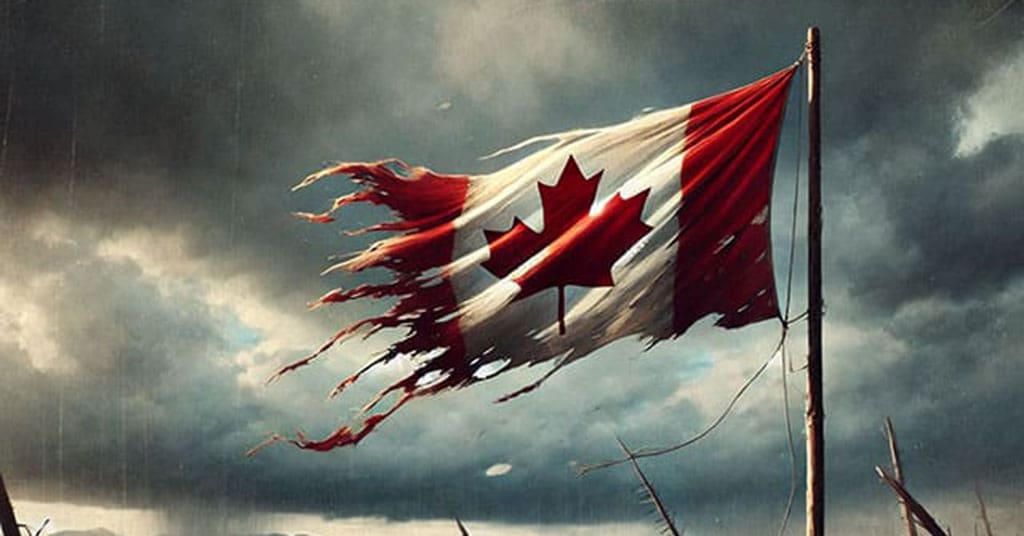
Ordinary Canadians are being branded as extremists for holding traditional values. The smear campaign is spreading on both sides of the border
A disturbing trend has taken hold in Canada and across the Western world, where freedom-lovers and conservatives are categorized as extremists and potential terrorists.
Another headline-grabbing example took place on July 8 when RCMP spokeswoman Staff Sgt. Camille Habel told a CBC interviewer about an alleged militia plot to seize land in Quebec. She said if someone “believed in equal gender rights” but suddenly leaned towards “traditional values … that might be a sign that they’re becoming more extremist.”
Alas, some prominent people have gone so far left that traditional values are “far right” to them. Consider a 2021 report by the House of Commons Standing Committee on Public Safety and National Security. The document said “Ideologically motivated violent extremism [IMVE] … represents a societal issue requiring a whole-of-government approach.”
The document warned that since the pandemic, “IMVE activity has been fueled by an increase in extreme anti-authority and anti-government rhetoric often rooted in the weaponization of conspiracy theories … IMVE influencers promote misinformation and action, including violence.”
The report complained that some witnesses to the committee did not embrace the IMVE term, and instead used phrases such as the “far right” or the “far‑right ecosystem.” Here, conservatives, conspiracy theorists and potential terrorists are one big, bad blob.
The tactic is old. In 1943, a Communist directive to American activists advised, “When certain obstructionists become too irritating, label them after suitable buildups as fascist or Nazi or anti-semitic, and use the prestige of anti-fascist and tolerance organizations to discredit them. In the public mind, we constantly associate those who oppose us with those names which already have a bad smell. The association will, after enough repetition, become fact in the public mind.”
This misrepresentation worked well against the Freedom Convoy. One mysterious person with a Nazi flag was enough to dismiss thousands of people as dangerous fascists. But spurious judgments like these malign many good people. This leads to misguided opposition against people who want to uphold Canada, not tear it down.
Trans-activists have their own form of name-shaming. They call out TERFs, meaning trans-exclusive radical feminists. These so-called TERFs believe that biological males have no place in women’s shelters, prisons and sports.
This kind of disparagement is all too common. In September 2023, Canadian labour leaders and at least one researcher from a major university joined in a Zoom call to strategize against the 1 Million March 4 Children, a nationwide protest against transgender ideology in schools. A leaked video of the Zoom call showed these leaders and activists using terms like “fascist,” “intolerance,” “hate group,” “transphobic” and “homophobic” against parents and other citizens who wanted ideological concepts on gender kept out of school.
Meanwhile, the Canadian Anti-Hate Network (CAHN) blacklisted Campaign Coalition for Life as a “hate movement” after receiving $640,000 from the federal government to compile a list of allegedly hateful organizations and people.
“We define ‘hate-promoting’ to refer to ideologies, groups, movements and individuals which target members of protected groups,” explained the CAHN booklet entitled 40 Ways to Fight the Far-Right; CAHN even hosts a one-hour workshop that lays out “the intersection between hate, the far-right, and conspiracy theories.”
This mirrors the United States where the left-leaning Southern Poverty Law Centre (SPLC) first made a list of bad organizations in 1990. Since 2000, the organization has compiled a “hate map” of these groups, which now number 835. As one example, SPLC calls the Family Research Council an “extremist” “hate group” due to their pro-life, pro-traditional marriage stances.
During Barack Obama’s second term as president, the Department of Defense (DoD) incorporated SPLC assessments into its training on domestic terrorism, leading to undue smears. In 2013, a DoD training presentation at Fort Hood, Texas, listed “Evangelical Christianity,” “Catholicism” and “Tea Party” as fostering extremism. In 2014, soldiers at Fort Bragg in North Carolina were told similar things about pro-gun and pro-life organizations.
In 2015, watchdog organization Judicial Watch openly called on the DoD to stop relying on the “anti-Christian” SPLC for its definitions, saying the group itself was hateful.
A teaching module presented to 9,100 soldiers at Fort Liberty through 2024 labelled National Right to Life and Operation Rescue as potential terrorist threats. Congressional Republicans protested this politicization of military training. In response, an army spokesperson echoed disclaimers made 10 years ago, saying the slides were not policy and were improperly vetted.
In July 2025, Army Secretary Dan Driscoll called it a “grievous error” to equate conservative groups with terrorists and vowed it would never happen again. Unfortunately, Canadians have no such assurances. We still endure police, academics, NGOs and even a federal government which calls the good guys the bad guys.
If we needed proof that society has traded good for evil, this is it.
Lee Harding is a research fellow with the Frontier Centre for Public Policy.
Explore more on Human Rights, Freedom, Hate crimes, Western values, Coercive progressivism
The views, opinions, and positions expressed by our columnists and contributors are solely their own and do not necessarily reflect those of our publication.
Troy Media empowers Canadian community news outlets by providing independent, insightful analysis and commentary. Our mission is to support local media in helping Canadians stay informed and engaged by delivering reliable content that strengthens community connections and deepens understanding across the country.

