
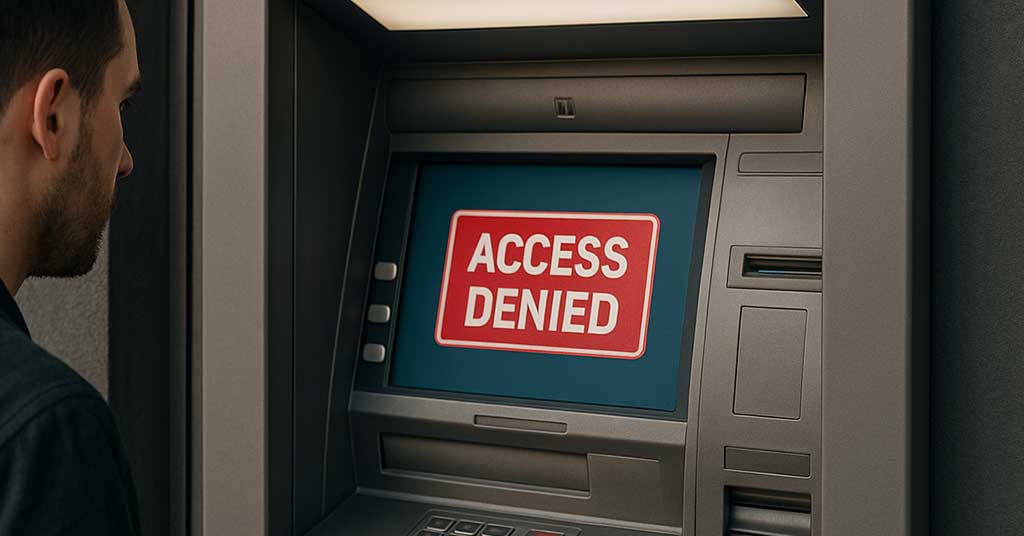
The rise of debanking threatens free speech and financial rights. Canadians have a right to be worried

If you thought bank account freezes ended after the 2022 convoy, think again. “Debanking”—the practice of banks abruptly closing accounts, often without a clear explanation—is on the rise in Canada and the U.S., and it’s fast becoming a tool to silence dissent.
Alberta lawyer Eva Chipiuk is a recent debanking victim. On July 17, the Royal Bank of Canada (RBC) sent her a letter saying she could no longer have an account there. She posted RBC’s letter, which offered little explanation beyond stating her recent account activity was “outside of RBC’s client risk appetite,” on X. She was told to transfer her funds to another financial institution within 31 days.
In an interview with the Financial Post, Chipiuk said she had made two $1,000 transfers to cryptocurrency platform Shakepay Inc. over two consecutive days to buy Bitcoin. The second transfer was blocked by the bank and triggered an account freeze. She went to the bank to have her account restored. A few days after succeeding, she received the letter saying her accounts would again be closed until mid-August.
While banks often flag cryptocurrency transactions for review because of anti-money-laundering regulations, such activity is lawful.
If that alone were grounds for debanking, more than four million Canadians would be at risk. According to the Triple A Global Cryptocurrency Report, about 10.1 per cent of Canadians own cryptocurrency.
However, buying crypto does not appear to be the real reason. Chipiuk represented protesters from the Freedom Convoy, which began in opposition to COVID-19 vaccine mandates and sweeping pandemic restrictions, and cross-examined then-prime minister Justin Trudeau in 2022 at the Public Order Emergency Commission hearings in Ottawa.
In 2022, Canadian banks froze $7.8 million from 200 accounts related to the convoy. A single mother in B.C. complained to her MP, Mark Strahl, that her bank account was frozen after giving a $50 donation to the convoy, which was legal at the time. In response, the prime minister and deputy prime minister said financial measures were meant only to target convoy leaders.
The convoy is over, but debanking is not. The Ombudsman for Banking Services and Investments opened 94 cases related to debanking in 2024 and 105 in 2023. A spokesperson for the organization told the Financial Post: “We are not able to challenge or change a bank’s decision. We are also generally not able to tell the consumer the bank’s reason for account closure.”
Debanking has also emerged as an issue in the United States. U.S. President Donald Trump complained about it in his Jan. 20 video conference with the World Economic Forum. He told Brian T. Moynihan, chair, president and CEO of Bank of America: “I hope you start opening your bank to conservatives because many conservatives complain that the banks are not allowing them to do business.”
Democratic Senator Elizabeth Warren agreed. At a Senate committee hearing on Feb. 8 entitled “Investigating the Real Impacts of Debanking in America,” she said: “Donald Trump was onto a real problem when he criticized Bank of America for its de-banking practices.”
Warren said de-banked U.S. customers “all reported common themes,” namely: “No warning. No explanation. No chance to dispute or appeal. They described how one day, all of a sudden, they lost their place in the banking system.” The Consumer Financial Protection Bureau has received 12,000 debanking complaints over the past three years. Georgia, Florida and Tennessee have introduced laws to curb debanking.
A completely de-banked person is left with only cash, but in Canada, Bill C-2 could significantly worsen their predicament. If passed, federal law will ban cash transactions of $10,000 or more to a business or non-profit for any given thing, whether that amount is in a lump sum or a series of payments.
Encroachments on free speech and financial rights are paving the way for a dystopian future, where those who refuse to bow to government diktat or bank-favoured ideologies are shut out of the financial system.
Canadians and Americans must defend their freedoms now, before a digital technocracy emerges to cancel and crush dissent.
Lee Harding is a research fellow for the Frontier Centre for Public Policy.
Explore more on Free speech, Cancel Culture, Abuse of power, Coercive progressivism
The views, opinions, and positions expressed by our columnists and contributors are solely their own and do not necessarily reflect those of our publication.
Troy Media empowers Canadian community news outlets by providing independent, insightful analysis and commentary. Our mission is to support local media in helping Canadians stay informed and engaged by delivering reliable content that strengthens community connections and deepens understanding across the country.

