
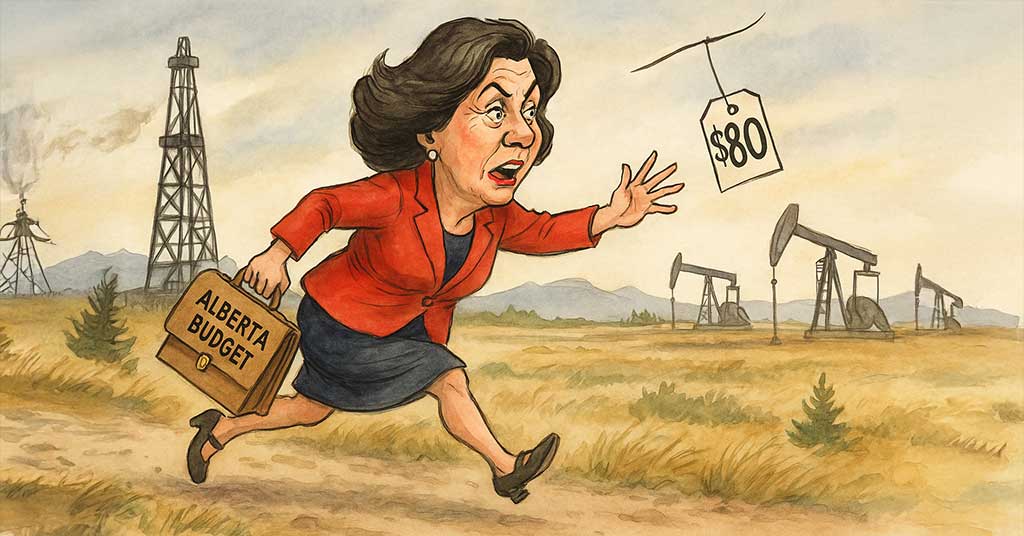
Alberta’s finances are sliding back into familiar boom-and-bust territory

News that the Alberta government will likely run higher deficits this year and next is no surprise—they’re the cost of building long-term government spending on volatile oil prices.
Using more realistic assumptions for West Texas Intermediate (WTI) oil prices—the global benchmark that determines how much Alberta earns from oil royalties—I now estimate that Alberta’s budget shortfalls will be $7.7 billion in 2025/26, $8.8 billion in 2026/27 and $7.6 billion in 2027/28.
These estimates are based on projected WTI prices of US$62.15 per barrel in 2025/26, US$65.00 in 2026/27 and US$67.00 in 2027/28. They also assume the government can hold its operating spending flat at $65 billion in 2026/27, rising to $66.5 billion in 2027/28—just a 2.5 per cent increase.
Between 2022/23 and 2025/26, Alberta’s operating expenses are projected to climb by more than $10.2 billion, a cumulative increase of nearly 19 per cent over three years.
This means Alberta would need oil prices to hit US$74.00 per barrel in 2025/26, US$76.35 in 2026/27 and US$77.50 in 2027/28 just to balance the books. That threshold is likely to rise as the province relies more on oil sands revenue, which mostly comes from projects that pay higher royalties only after companies have recovered their upfront development and operating costs, even as spending continues to grow.
Back in 2023/24, a US$1.00 drop in oil prices over the course of a fiscal year meant about $630 million less for Alberta’s government. By 2025/26, that number rises to $750 million. By the end of this decade, a US$1.00 drop could mean as much as $1 billion in lost revenue for the province.
The fact that Alberta may need to make big changes just to balance the books over the next three years shows how deeply it now depends on volatile oil revenues. No wonder the premier has asked the minister of energy and minerals to develop a plan to hit six million barrels of daily production by 2030 and eight million by 2035. But those targets are far above what most industry experts think is realistic, given current conditions in global energy markets. Pretending that Alberta can keep growing long-term spending in areas like health care, education and social services using unpredictable oil income is a recipe for trouble.
Premier Danielle Smith’s new mandate letter to the president of Treasury Board and minister of finance repeats two short-term goals: grow the Alberta Heritage Savings Trust Fund (AHSTF) to at least $35 billion by 2027 and keep Alberta’s net debt-to-GDP ratio the lowest in Canada.
But based on reasonable forecasts and expected investment returns, it looks like the province will fall about $1.3 billion short of its AHSTF target by March 31, 2027. A nine per cent debt-to-GDP ratio may sound impressive, but Alberta could still add $28 billion in new debt and remain the lowest in Canada. That’s hardly a model of discipline. The government should consider putting a firm limit in law, capping net debt at no more than 15 per cent of GDP to help keep future budgets under control.
Beyond how Alberta compares to other provinces, the real issue is what that debt means for the people living here.
A growing debt burden means more public dollars spent on interest payments instead of services. It limits the province’s flexibility to respond to downturns or invest in future growth. And it passes growing financial risk to future governments and taxpayers.
Albertans have seen this movie before. In the 1980s and 1990s, a collapse in oil prices left the province scrambling to close budget gaps through painful cuts. Even in the more recent downturns of 2008 and 2015, oil price shocks triggered a wave of fiscal instability, job losses and spending freezes. Without reform, history will repeat itself again.
I’ve laid out the key challenges behind Alberta’s financial bind and offered a few ways forward. The first step is transparency. The Smith government should give Albertans a full financial update by the end of November 2025 and restore the legal requirement for a mid-year fiscal and economic report, with detailed projections for the next two years.
Without change, Alberta risks repeating the same boom-and-bust cycles that have hurt its finances in the past where even small dips in oil prices force deep cuts or big borrowing.
Lennie Kaplan is a former senior manager in the fiscal and economic policy division of Alberta’s Ministry of Treasury Board and Finance, where, among other duties, he examined best practices in fiscal frameworks, program reviews and savings strategies for non-renewable resource revenues. In 2012, he won a Corporate Values Award in TB&F for his work on Alberta’s fiscal framework review. In 2019, Mr. Kaplan served as executive director to the MacKinnon Panel on Alberta’s finances—a government-appointed panel tasked with reviewing Alberta’s spending and recommending reforms.
Explore more on Alberta budget, Alberta debt and deficit, Alberta taxes, Energy sector, Smith government
The views, opinions, and positions expressed by our columnists and contributors are solely their own and do not necessarily reflect those of our publication.
Troy Media empowers Canadian community news outlets by providing independent, insightful analysis and commentary. Our mission is to support local media in helping Canadians stay informed and engaged by delivering reliable content that strengthens community connections and deepens understanding across the country.

