
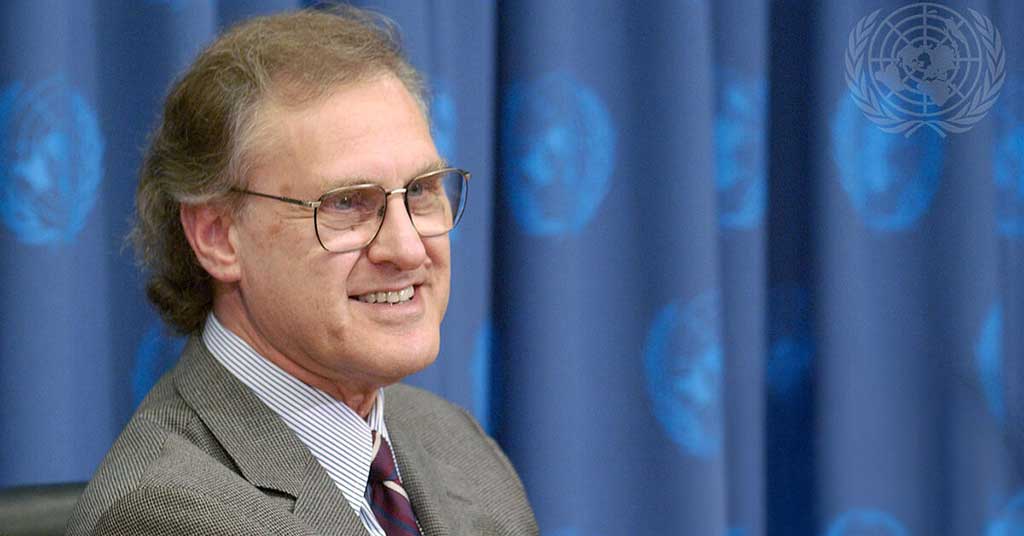
Lewis proved that strong NDP convictions and civility can coexist

It’s probably fair to describe Stephen Lewis as the most successful New Democrat on the domestic and international scene. That’s why there was a large outpouring of support from Canada’s left when the 88-year-old political stalwart passed away on March 31 after a long battle against abdominal cancer.
In spite of the pain and suffering he was surely experiencing, he lived just long enough to see his son, Avi, become federal NDP leader. One can only imagine how proud he was to have the third generation of his family in charge of a party and movement that meant so much to him.
Lewis’s father, David, was federal NDP leader from 1971 to 1975. A lifelong social democrat and staunch anti-communist, he was a Rhodes scholar at Oxford University and a skilled debater in the Oxford Union. David became well connected in British Labour Party circles and was offered a safe seat to run for the party. A June 19, 1935, letter from Co-operative Commonwealth Federation leader J.S. Woodsworth asking him to come back to Canada helped change his mind and the course of his life.
After losing his first few campaigns, David won a seat in the federal riding of York South in 1962. He lost to Liberal candidate Marvin Gelber the following year but beat him in 1965 to regain it. He won the party leadership after a four-ballot tussle with James Laxer and used his memorable 1972 campaign slogan of fighting the “corporate welfare bums” to achieve a then-record 31 seats and the balance of power in a minority Liberal parliament. Two years later, his party would slip to 16 seats, and he lost York South for the final time to Liberal candidate Ursula Appolloni.
Lewis, unlike his father, never finished university and dropped out of law school twice. This had nothing to do with incompetence and everything to do with political ambition. He had become a high-profile figure after debating then-U.S. senator John F. Kennedy at the University of Toronto’s Hart House on Nov. 14, 1957. While no audio or video clips exist, several observers that evening said Lewis’s performance was the highlight and Kennedy was less than stellar. Although the senator won the Hart House debate by a close 204-194 margin, the young socialist had made his mark.
While working at Socialist International, Lewis was invited to speak at a conference in Ghana and stayed in Africa for an additional year. He returned to Canada at then-federal NDP leader Tommy Douglas’s request, ran for the Ontario NDP in 1963 and became a provincial MPP in Scarborough West at age 26. Lewis was elected party leader in 1970 and his father took charge of the federal outfit the following year. It’s a feat that hasn’t been duplicated since.
In the 1975 provincial election, Lewis increased the NDP’s seat count from 19 to 38 and became official opposition leader. His party fell to 33 seats in the 1977 election and the Liberals took back the official opposition role. Frustrated by this result, he stepped down as leader in 1978 and left provincial politics for good.
Lewis would have a long and successful career in other ways, means and avenues.
Then-Progressive Conservative prime minister Brian Mulroney, on the advice of former Ontario PC premier Bill Davis, appointed Lewis as Canada’s ambassador to the United Nations in 1984. While initially viewed with more than a modicum of surprise and shock, it actually made sense. Mulroney and Lewis were political opposites, but they were both strongly opposed to apartheid in South Africa. It was this shared interest that enabled two of Canada’s finest orators to successfully work together until 1988.
Lewis was later appointed special advisor on race relations to then-Ontario NDP premier Bob Rae in 1992. He also served as UNICEF’s deputy executive director and the United Nations special envoy for HIV/AIDS in Africa, started the Stephen Lewis Foundation, was a scholar-in-residence at McMaster University, and more.
It’s all rather impressive when you consider that Lewis’s political ideology was pretty far to the left. Just like his wife, former Toronto Star columnist Michele Landsberg. Just like Avi and his wife, political activist Naomi Klein. Just like most of his family, in fact.
Yet, Lewis was the most diplomatic of his politically dogmatic family. He always spoke in a reasonable, level-headed manner with people who fundamentally disagreed with him on most issues. This included Davis, Mulroney, my father, Stanley, who lived near him and infrequently went over to the Lewis house for dinner and, on two occasions, me.
How was he able to do this? It was actually revealed more than a decade ago.
During a Nov. 21, 2013, interview on TVO’s The Agenda, which examined the Hart House debate, the topic of JFK’s assassination came up. While Lewis acknowledged that he was sad about what happened, it didn’t match the same intensity that other people felt. In his view, he wasn’t a “raw, emotional person.” When TVO host Steve Paikin disagreed with this assessment, Lewis provided a fascinating rebuttal. “I think it’s partly because of being kind of sullied by socialism,” he said. “You know, when you have such intense ideological convictions, everything falls within that frame. And the likes and dislikes emerge within—that’s the way you measure things.”
This is the mark of a true political ideologue. Never waver in your beliefs and convictions, but always take a civil, friendly approach when speaking with others who will never see things your way. That’s how Lewis became the most successful New Democrat in Canada and the world. His fellow left-wing travellers could learn something from this. RIP.
Michael Taube is a political commentator, Troy Media syndicated columnist and former speechwriter for Prime Minister Stephen Harper. He holds a master’s degree in comparative politics from the London School of Economics, lending academic rigour to his political insights.
Explore more on NDP, Canadian political history
The views, opinions, and positions expressed by our columnists and contributors are solely their own and do not necessarily reflect those of our publication.
Troy Media empowers Canadian community news outlets by providing independent, insightful analysis and commentary. Our mission is to support local media in helping Canadians stay informed and engaged by delivering reliable content that strengthens community connections and deepens understanding across the country.

